Concentrative Textile Enzymes for Reliable Textile Processing
Troubleshoot concentrative textile enzymes for denim, bio-polishing and finishing with dosage, pH, temperature, QC and sourcing guidance.
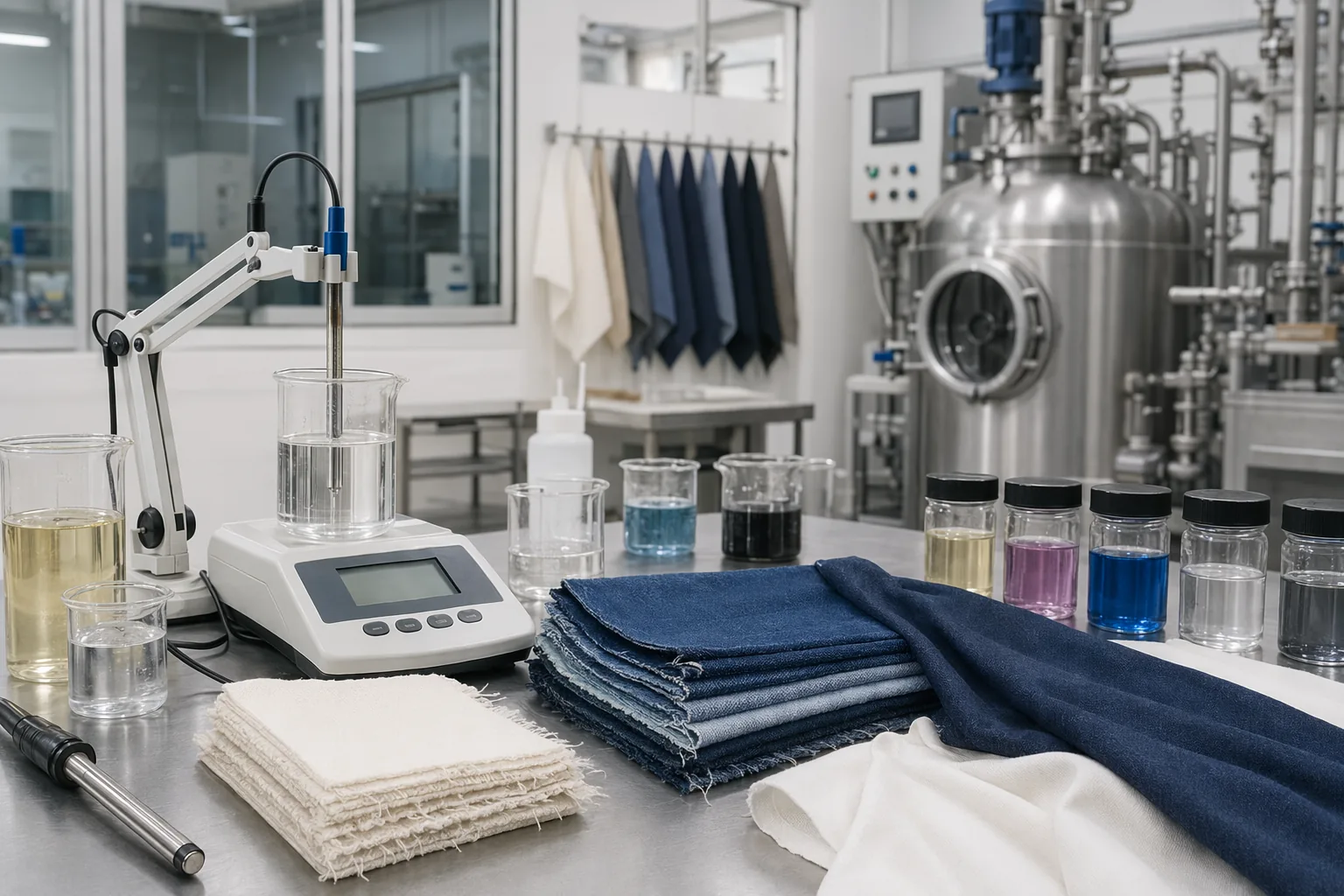
Optimize textile processing with enzymes by matching enzyme type, dosage, pH, temperature, dwell time and mechanical action to the fabric, machinery and finish target.
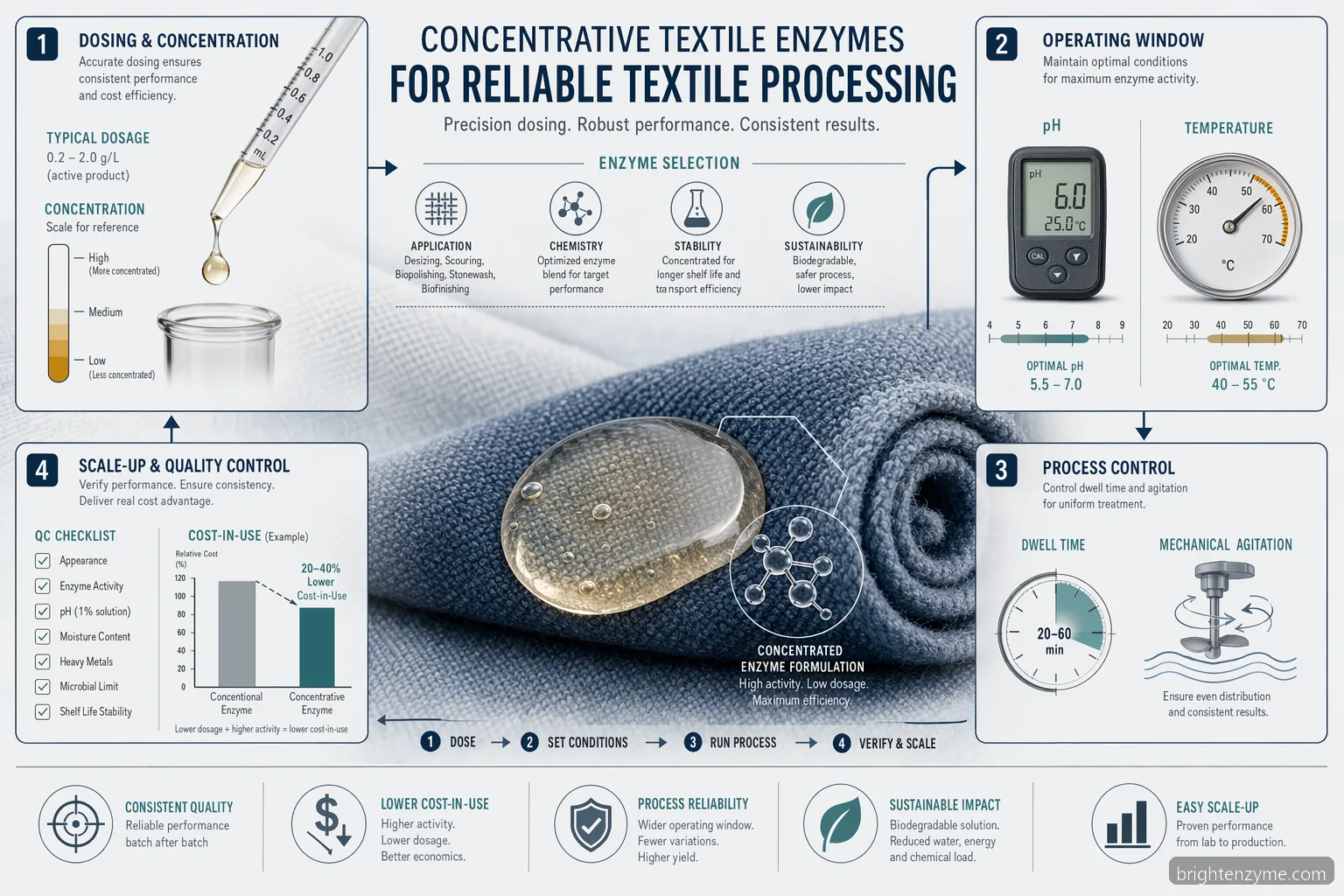
Why concentrated enzyme selection matters
Concentrative textile enzymes are high-activity formulations used at lower addition rates than standard liquid or powder products. For mills, garment laundries and fabric finishers, the commercial question is not simply enzyme strength; it is whether the enzyme performs consistently under real bath conditions. In textile processing with enzymes, liquor ratio, water hardness, pH drift, temperature ramp, salt, surfactants, dyestuff residues and mechanical action all affect results. A concentrated product can reduce storage space and freight cost, but overdosing may increase fiber damage, shade variation or loss of hand feel. Underdosing may leave incomplete desizing, poor bio-polishing or uneven denim abrasion. Buyers should ask textile enzymes manufacturers for activity units, recommended dilution practice, shelf-life, compatible auxiliaries and case data from similar machines. A controlled trial should compare appearance, absorbency, weight loss, tensile strength and cost-in-use against the current process.
Assess activity per kilogram and activity delivered per bath. • Confirm whether dosing is recommended as g/L, % owg or activity units. • Check handling requirements for liquid, granular or powder formats.
Troubleshooting dosage in enzyme textile processing
Dosage problems are among the most common issues with enzymes in the textile industry. A practical starting band for cellulase bio-polishing or denim finishing is often 0.1–1.0% owg, or approximately 0.5–3.0 g/L depending on concentration and equipment. Amylase desizing may run around 0.5–2.0 g/L for many woven goods, while catalase after peroxide bleaching is commonly optimized at low g/L or sub-g/L dosage based on residual peroxide. These values are only starting points; enzyme activity, substrate load and dwell time must be tested. If the finish is weak, first confirm pH, bath temperature, agitation and liquor ratio before increasing dosage. If strength loss or excessive weight reduction occurs, reduce dosage or time and stop the enzyme quickly by pH shift, heat, washing or chemistry recommended in the TDS.
Use lab dips before bulk production. • Record actual bath pH and temperature, not only set points. • Compare visual finish with weight loss and tensile data.
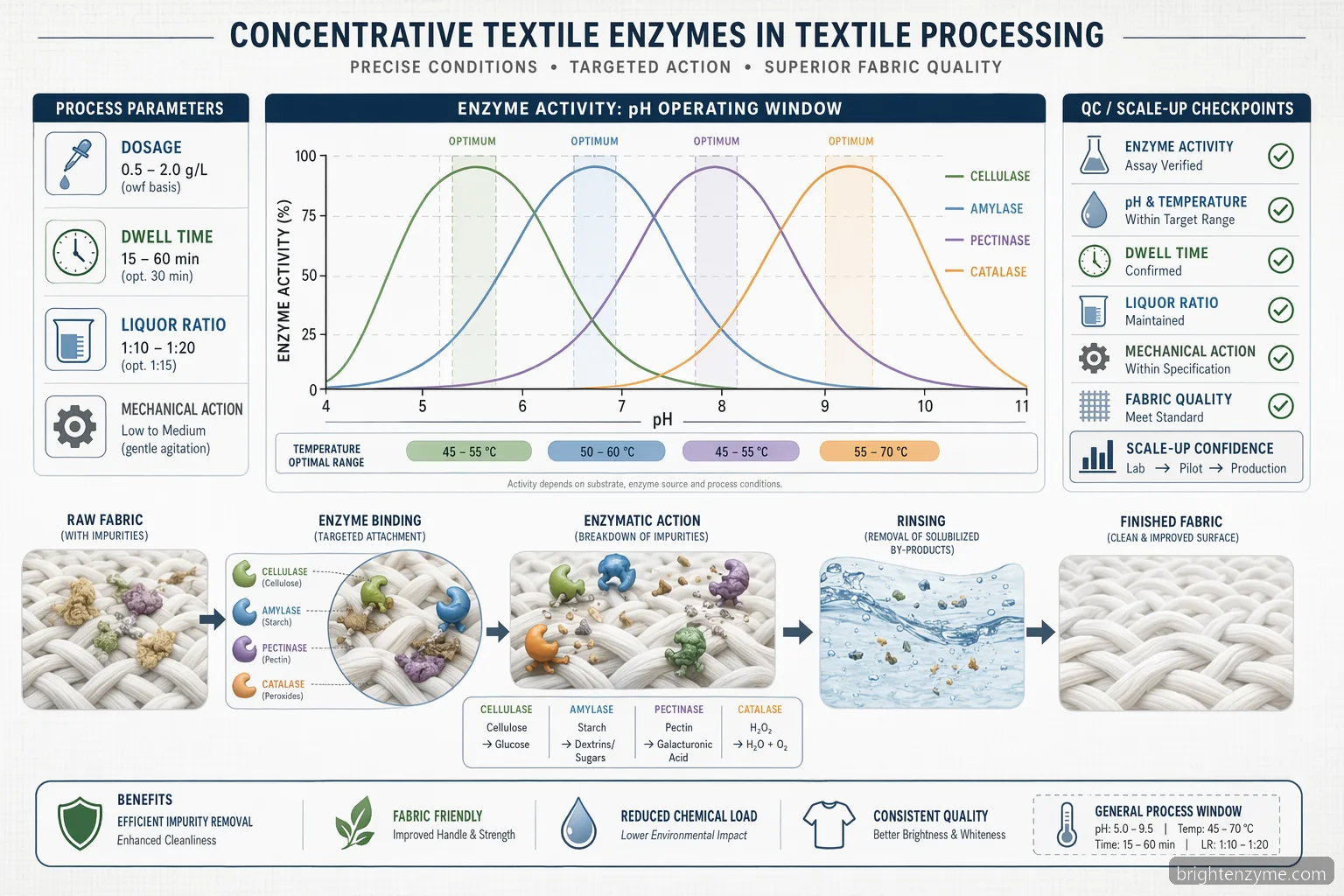
pH and temperature windows by enzyme type
The best operating window depends on the enzyme used in textile industry applications. Acid cellulase for denim and cotton bio-polishing often performs near pH 4.5–5.5 and 45–60°C, while neutral cellulase may operate closer to pH 6.0–7.0 and 45–60°C with lower backstaining risk in selected systems. Alpha-amylase desizing is commonly run near pH 5.5–7.0 and 55–90°C depending on whether the product is medium-temperature or high-temperature stable. Pectinase for cotton scouring may work around pH 7.0–9.0 and 45–60°C. Laccase textile applications for indigo or specialty finishing are commonly evaluated near pH 4.0–6.0 and 40–60°C, depending on mediator system and shade target. Operating outside the supplier’s range may slow reaction, cause uneven results or deactivate the enzyme before the target effect is achieved.
Calibrate pH meters and temperature probes regularly. • Avoid assuming one enzyme type can replace another directly. • Validate compatibility with buffers, wetting agents and detergents.
QC checks before scale-up
Reliable textile enzymes market purchasing requires a repeatable QC plan. Before approving a new textile enzymes manufacturer, run bench, pilot and production-scale checks. For desizing, evaluate starch removal by iodine spot test and confirm absorbency. For bio-polishing, measure pilling grade, fabric weight loss, hand feel and tensile or tear strength. For denim, inspect abrasion level, backstaining, shade cast and reproducibility across garment positions. For catalase, measure residual hydrogen peroxide before dyeing to avoid shade problems. For laccase textile finishing, check color change, contrast and wash reproducibility. Retain untreated control samples and current-process controls. Production teams should document bath volume, loading, fabric type, lot number, enzyme lot, dosage, pH, temperature, time and deactivation step so failures can be traced and corrected.
Request COA for each lot and compare activity specifications. • Keep reference swatches under controlled lighting. • Use pilot validation before changing bulk production recipes.
Supplier qualification and cost-in-use
A strong supplier evaluation goes beyond catalog claims. B2B buyers should request a current TDS, SDS and COA, then confirm whether the stated activity method is relevant to the mill’s fabric and process. Ask about batch-to-batch tolerance, recommended storage temperature, transport conditions, dilution stability and technical support for trial design. Cost-in-use should include enzyme dose, bath time, water and energy impact, rework rate, shade rejects, fabric loss and inventory handling. In many cases, a higher-priced concentrated enzyme can be economical if it reduces dosage, shortens processing or improves first-pass quality. However, mills should avoid switching solely on theoretical activity. Validate the product on representative fabrics, dyestuffs and machines, then approve the supplier through documented performance, quality, logistics and regulatory documentation review.
Compare cost per finished kilogram or garment, not only cost per drum. • Confirm lead time, packaging size and shelf-life. • Review SDS handling guidance with EHS and production teams.
Technical Buying Checklist
Buyer Questions
Start with the supplier’s TDS range, then run a small dosage ladder on the actual fabric and machine type. For cellulase, many trials begin around 0.1–1.0% owg; for amylase, around 0.5–2.0 g/L is common. Confirm pH, temperature, time and liquor ratio. Select the lowest dose that meets the target finish without unacceptable strength loss, shade movement or rework.
Poor results often come from pH or temperature outside the active range, insufficient dwell time, low mechanical action, incorrect dilution, hard water, incompatible auxiliaries or fabric variation. Do not increase dosage until process conditions are verified. Check enzyme storage, lot COA, bath pH, actual fabric loading and deactivation method. Comparing treated samples with an untreated control usually identifies whether the issue is chemistry, machinery or substrate.
A qualified textile enzymes manufacturer should provide a technical data sheet with application guidance, a safety data sheet for handling and storage, and a certificate of analysis for each lot. Buyers may also request shelf-life, packaging, activity method, recommended storage temperature and compatibility information. These documents support supplier qualification, EHS review, incoming QC and troubleshooting if production performance changes.
Cost-in-use is calculated from the enzyme dose required to finish a kilogram of fabric or a garment, plus the process impact. Include enzyme price, dosage, bath time, water, energy, neutralization or deactivation, rejects, rewash rate, fabric strength loss and inventory cost. A concentrated enzyme may cost more per kilogram but still reduce total cost if it improves first-pass quality or lowers dosage.
Laccase textile enzymes are typically considered for specialty denim effects, indigo modification and selected oxidative finishing processes. They require careful shade validation because results depend on dye chemistry, pH, temperature, time and any mediator system used. Pilot testing should evaluate color cast, contrast, reproducibility and impact on downstream washing. Laccase is not a universal replacement for cellulase or chemical bleaching.
Textile Processing Enzymes for Research & Industry
Need Textile Processing Enzymes for your lab or production process?
ISO 9001 certified · Food-grade & research-grade · Ships to 80+ countries
Frequently Asked Questions
How should mills start dosing concentrative textile enzymes?
Start with the supplier’s TDS range, then run a small dosage ladder on the actual fabric and machine type. For cellulase, many trials begin around 0.1–1.0% owg; for amylase, around 0.5–2.0 g/L is common. Confirm pH, temperature, time and liquor ratio. Select the lowest dose that meets the target finish without unacceptable strength loss, shade movement or rework.
What causes poor results in textile processing with enzymes?
Poor results often come from pH or temperature outside the active range, insufficient dwell time, low mechanical action, incorrect dilution, hard water, incompatible auxiliaries or fabric variation. Do not increase dosage until process conditions are verified. Check enzyme storage, lot COA, bath pH, actual fabric loading and deactivation method. Comparing treated samples with an untreated control usually identifies whether the issue is chemistry, machinery or substrate.
Which documents should textile enzymes manufacturers provide?
A qualified textile enzymes manufacturer should provide a technical data sheet with application guidance, a safety data sheet for handling and storage, and a certificate of analysis for each lot. Buyers may also request shelf-life, packaging, activity method, recommended storage temperature and compatibility information. These documents support supplier qualification, EHS review, incoming QC and troubleshooting if production performance changes.
How is cost-in-use calculated for enzymes in textile industry operations?
Cost-in-use is calculated from the enzyme dose required to finish a kilogram of fabric or a garment, plus the process impact. Include enzyme price, dosage, bath time, water, energy, neutralization or deactivation, rejects, rewash rate, fabric strength loss and inventory cost. A concentrated enzyme may cost more per kilogram but still reduce total cost if it improves first-pass quality or lowers dosage.
When should laccase textile enzymes be considered?
Laccase textile enzymes are typically considered for specialty denim effects, indigo modification and selected oxidative finishing processes. They require careful shade validation because results depend on dye chemistry, pH, temperature, time and any mediator system used. Pilot testing should evaluate color cast, contrast, reproducibility and impact on downstream washing. Laccase is not a universal replacement for cellulase or chemical bleaching.
Related: Textile Processing Enzymes for Faster, Cleaner Finishing
Contact Bright Enzyme for textile enzyme selection, pilot trial guidance and COA/TDS/SDS review for your mill process. See our application page for Textile Processing Enzymes for Faster, Cleaner Finishing for specs, MOQ, and a free 50 g sample.
Contact Us to Contributehello@mail.brightenzyme.com