French English Glossay Textile Enzymes: Process Troubleshooting Guide
French English glossay textile enzymes guide with dosage, pH, temperature, QC, COA/TDS/SDS, and supplier checks for mills.
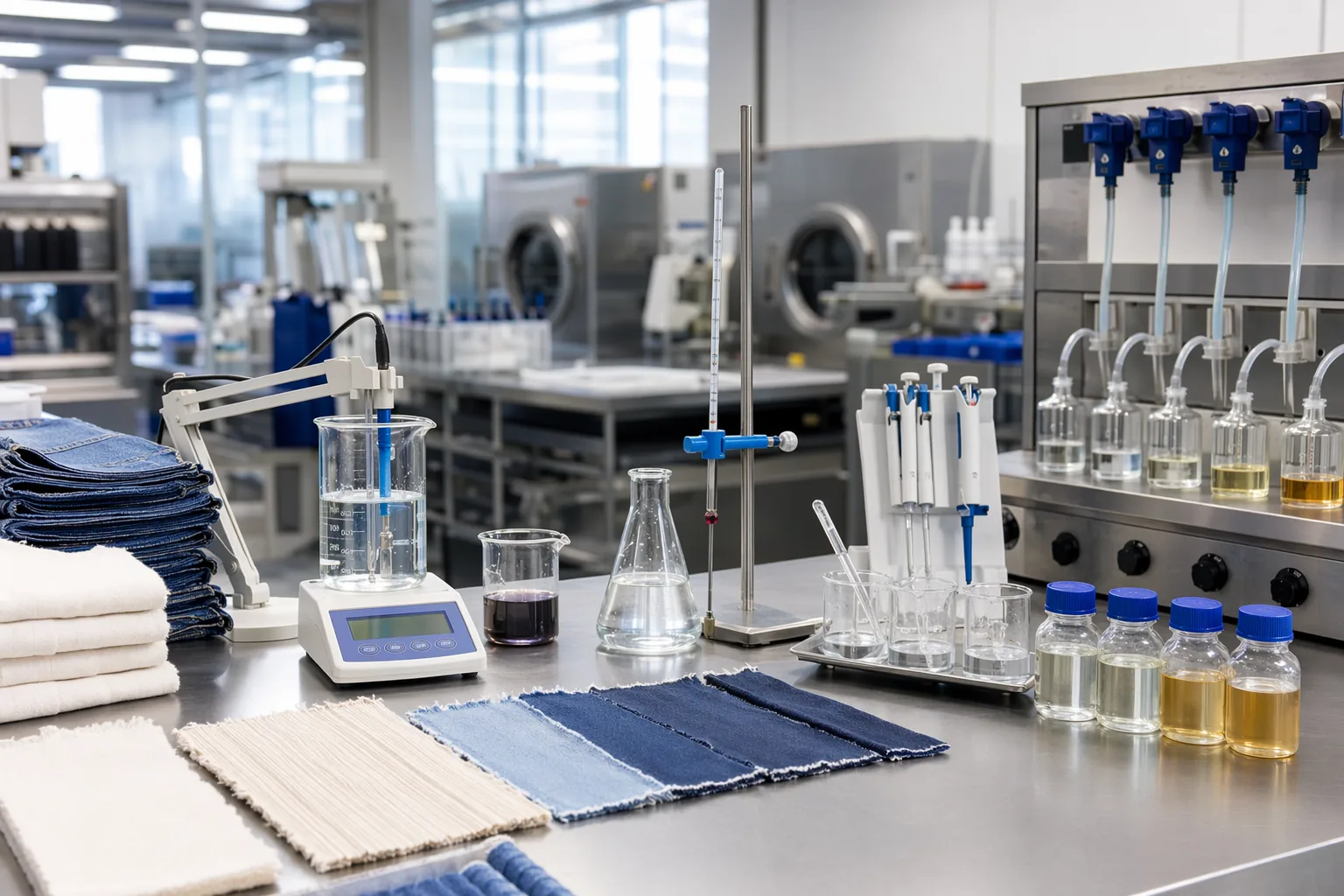
A practical B2B guide for textile mills comparing enzyme terms, dosage windows, pH, temperature, QC checks, and supplier data for reliable fabric finishing.
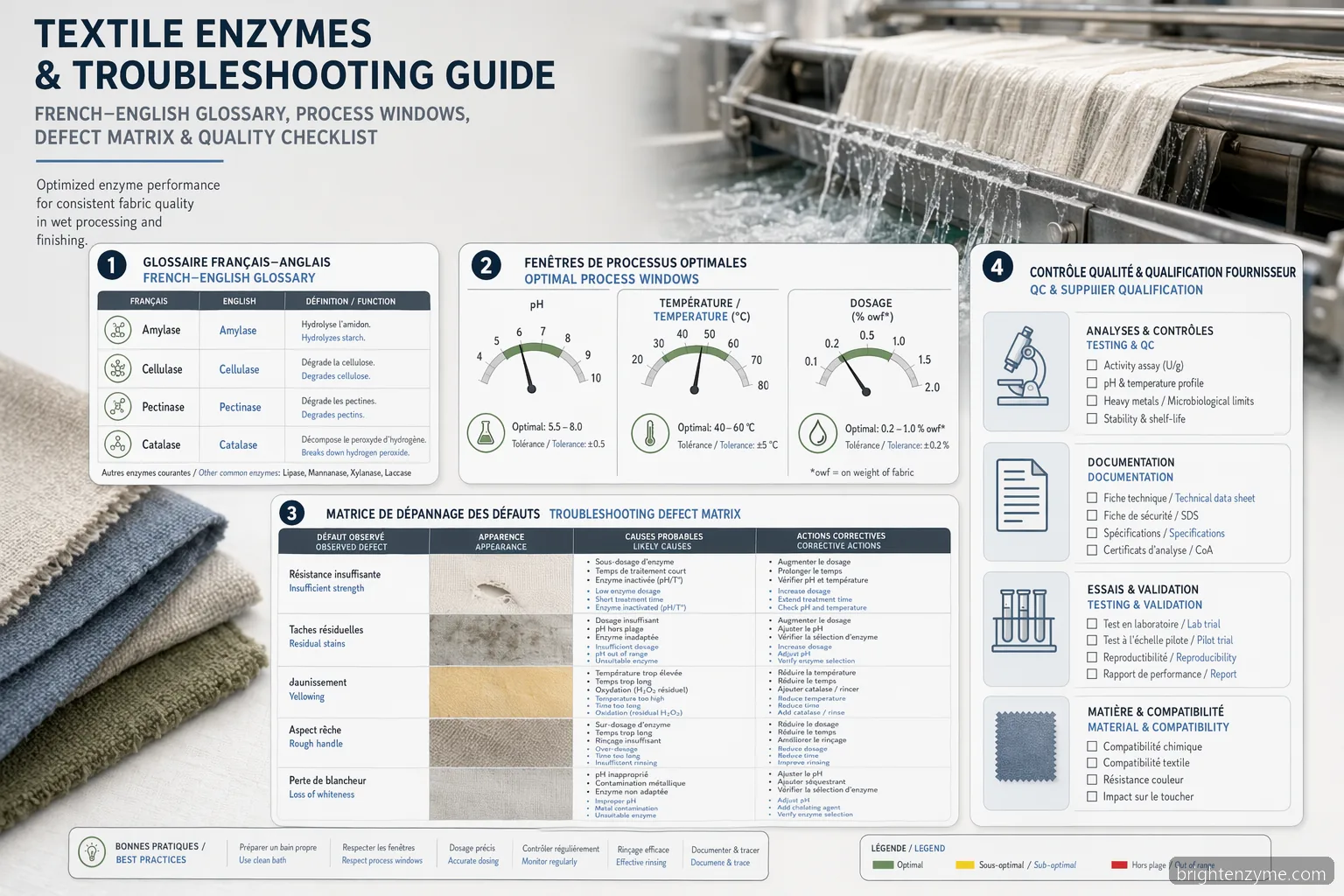
French-English glossary for common textile enzymes
Buyers searching for a french english glossay textile enzymes often need clear process vocabulary before troubleshooting a wet processing line. In French, enzyme de désencollage usually refers to amylase used to remove starch size. Biopolissage is biopolishing, commonly performed with cellulase to reduce surface fibrils on cotton, viscose, lyocell, or blends. Bioscouring may be translated as bioscourçage or préparation enzymatique, often using pectinase systems. Catalase is catalase in both languages and is used for peroxide kill before dyeing. Laccase textile applications may appear as laccase pour denim, décoloration enzymatique, or finition enzymatique. For international purchasing, confirm the intended substrate, pretreatment chemistry, dye class, and machinery before comparing offers from textile enzymes manufacturers. A useful glossary should connect each term to a process window, QC endpoint, and potential defect, because translation alone will not prevent shade variation, strength loss, or incomplete preparation.
French: désencollage enzymatique = enzyme desizing • French: biopolissage = biopolishing with cellulase • French: bioscourçage = enzymatic scouring • French: finition denim enzymatique = enzymatic denim finishing
Typical dosage, pH, and temperature windows
Textile processing with enzymes works best when the recipe matches the enzyme activity profile and fabric construction. Alpha-amylase desizing is commonly run around pH 5.5-7.0 at 50-70 C for 20-60 minutes, with dosage adjusted to starch load and supplier activity. Acid cellulase biopolishing often runs at pH 4.5-5.5 and 45-55 C, while neutral cellulase systems may operate near pH 6.0-7.5 for lower backstaining risk in some denim programs. Pectinase bioscouring is often evaluated near pH 7.0-9.0 at 45-60 C. Catalase peroxide removal is typically used around pH 6.0-8.5 at 30-50 C until residual peroxide is below the dyehouse limit. Laccase textile processes can require pH 4.0-6.0 and 40-60 C, depending on substrate and auxiliaries. These are starting bands only; always follow the TDS and confirm with pilot validation.
Start with supplier dosage guidance, then optimize by activity, liquor ratio, and fabric weight. • Use buffer or controlled acid/alkali addition when pH drift causes inconsistent performance. • Record actual bath temperature, not only machine setpoint.
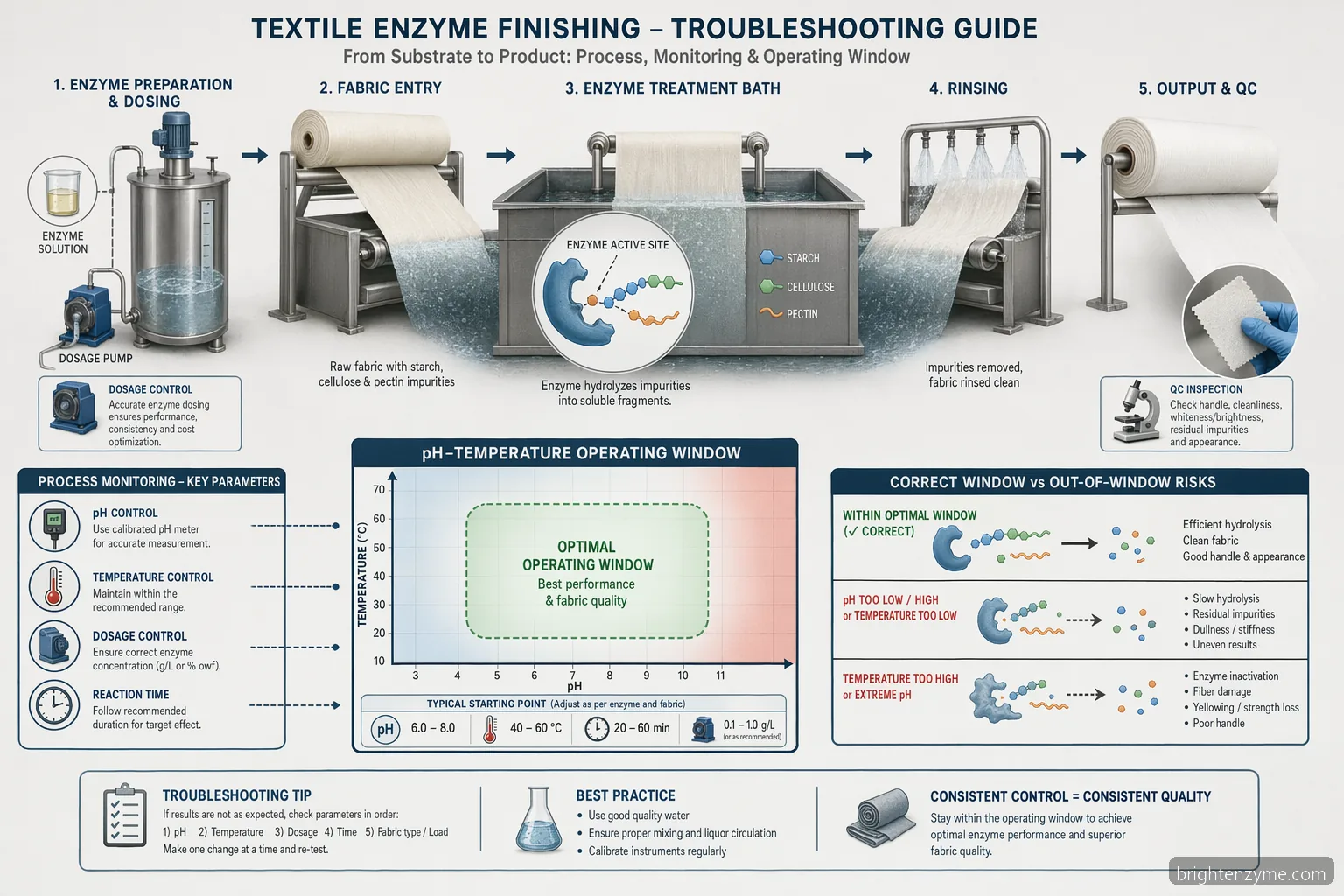
Troubleshooting defects in enzyme textile processing
When enzymes in the textile industry underperform, the root cause is often outside the enzyme drum. Incomplete desizing can result from low wet pick-up, insufficient time, incompatible surfactants, or starch levels beyond the trial recipe. Excessive biopolishing weight loss may come from overdosage, high temperature, low pH, long holding time, or strong mechanical action. Denim backstaining can increase when cellulase selection, dispersing agents, liquor exchange, or rinsing sequence is poorly controlled. Uneven absorbency after bioscouring may indicate residual waxes, fabric contamination, hard water, or inadequate wetting. Dye shade variation after catalase treatment can occur if residual peroxide is not checked before dyeing. For laccase textile applications, color change should be assessed against approved lab dips and restricted to qualified styles. Maintain a fault log linking enzyme lot, COA activity, pH, temperature, time, fabric batch, and QC outcome.
Check iodine test for desizing efficiency. • Measure absorbency by drop test or wicking method. • Track weight loss and tensile or tear strength after cellulase. • Confirm peroxide residual before reactive dyeing. • Assess shade, backstaining, and handfeel against approved standards.
How to qualify a textile enzymes manufacturer
The textile enzymes market includes many suppliers, but a qualified textile enzymes manufacturer should provide more than a quotation. Request the COA for each lot, the TDS with activity definition and process window, the SDS for safe handling, and storage conditions with shelf-life. Ask how activity is standardized, which application data supports the enzyme, and whether the supplier can help with lab-to-bulk scale-up. Compare cost-in-use by calculating grams or milliliters per kilogram of fabric, reprocessing reduction, water and energy impact, cycle time, and reject rate. Pilot validation should include your fabric, dyestuff, auxiliaries, machine type, local water, and target QC limits. Avoid accepting broad claims without trial evidence. For strategic purchasing, audit traceability, packaging integrity, batch consistency, technical response time, and change notification practices before approving long-term supply.
Mandatory documents: COA, TDS, SDS, and lot traceability. • Commercial comparison: cost-in-use, not only unit price. • Scale-up requirement: lab, pilot, then controlled bulk run.
Technical Buying Checklist
Buyer Questions
Common enzymes used in textile industry applications include amylase for starch desizing, cellulase for biopolishing and denim abrasion, pectinase for bioscouring, catalase for peroxide removal, and laccase for selected denim or color modification processes. The correct choice depends on fiber type, pretreatment chemistry, machinery, pH, temperature, processing time, and the mill’s quality target.
Start with the supplier TDS dosage band, then run lab and pilot trials using the actual fabric, auxiliaries, water, machine action, and liquor ratio. Measure the relevant QC endpoint, such as desizing efficiency, absorbency, weight loss, strength, residual peroxide, shade, or backstaining. The approved bulk dosage should be based on cost-in-use and reproducibility, not only the lowest enzyme addition.
A qualified supplier should provide a COA for lot-specific activity or quality data, a TDS with application guidance, an SDS for safe handling, storage and shelf-life information, and traceable batch identification. For regular production, buyers should also request change notification practices, packaging details, technical support contacts, and pilot trial recommendations relevant to textile processing with enzymes.
Cellulase can reduce fabric strength when dosage, time, pH, temperature, or mechanical action is too aggressive for the substrate. Lightweight fabrics, regenerated cellulosics, and already weakened goods need tighter controls. Monitor weight loss, tensile or tear strength, surface appearance, and handfeel during trials. Stop the process by draining, rinsing, pH adjustment, or temperature change according to supplier guidance.
Textile Processing Enzymes for Research & Industry
Need Textile Processing Enzymes for your lab or production process?
ISO 9001 certified · Food-grade & research-grade · Ships to 80+ countries
Frequently Asked Questions
Which enzymes are used in textile industry applications?
Common enzymes used in textile industry applications include amylase for starch desizing, cellulase for biopolishing and denim abrasion, pectinase for bioscouring, catalase for peroxide removal, and laccase for selected denim or color modification processes. The correct choice depends on fiber type, pretreatment chemistry, machinery, pH, temperature, processing time, and the mill’s quality target.
How should a mill set enzyme dosage for bulk production?
Start with the supplier TDS dosage band, then run lab and pilot trials using the actual fabric, auxiliaries, water, machine action, and liquor ratio. Measure the relevant QC endpoint, such as desizing efficiency, absorbency, weight loss, strength, residual peroxide, shade, or backstaining. The approved bulk dosage should be based on cost-in-use and reproducibility, not only the lowest enzyme addition.
What documents should textile enzymes manufacturers provide?
A qualified supplier should provide a COA for lot-specific activity or quality data, a TDS with application guidance, an SDS for safe handling, storage and shelf-life information, and traceable batch identification. For regular production, buyers should also request change notification practices, packaging details, technical support contacts, and pilot trial recommendations relevant to textile processing with enzymes.
Why does cellulase sometimes damage fabric strength?
Cellulase can reduce fabric strength when dosage, time, pH, temperature, or mechanical action is too aggressive for the substrate. Lightweight fabrics, regenerated cellulosics, and already weakened goods need tighter controls. Monitor weight loss, tensile or tear strength, surface appearance, and handfeel during trials. Stop the process by draining, rinsing, pH adjustment, or temperature change according to supplier guidance.
Related: Textile Processing Enzymes for Faster, Cleaner Finishing
Contact Bright Enzyme for COA-backed textile enzyme samples, pilot support, and cost-in-use evaluation for your mill. See our application page for Textile Processing Enzymes for Faster, Cleaner Finishing for specs, MOQ, and a free 50 g sample.
Contact Us to Contributehello@mail.brightenzyme.com