Sciencedaily Textile Enzymes: Formulation Guide for Textile Processing
Textile enzyme formulation guide with pH, temperature, dosage, QC, COA/TDS/SDS, pilot validation, cost-in-use, and supplier checks.
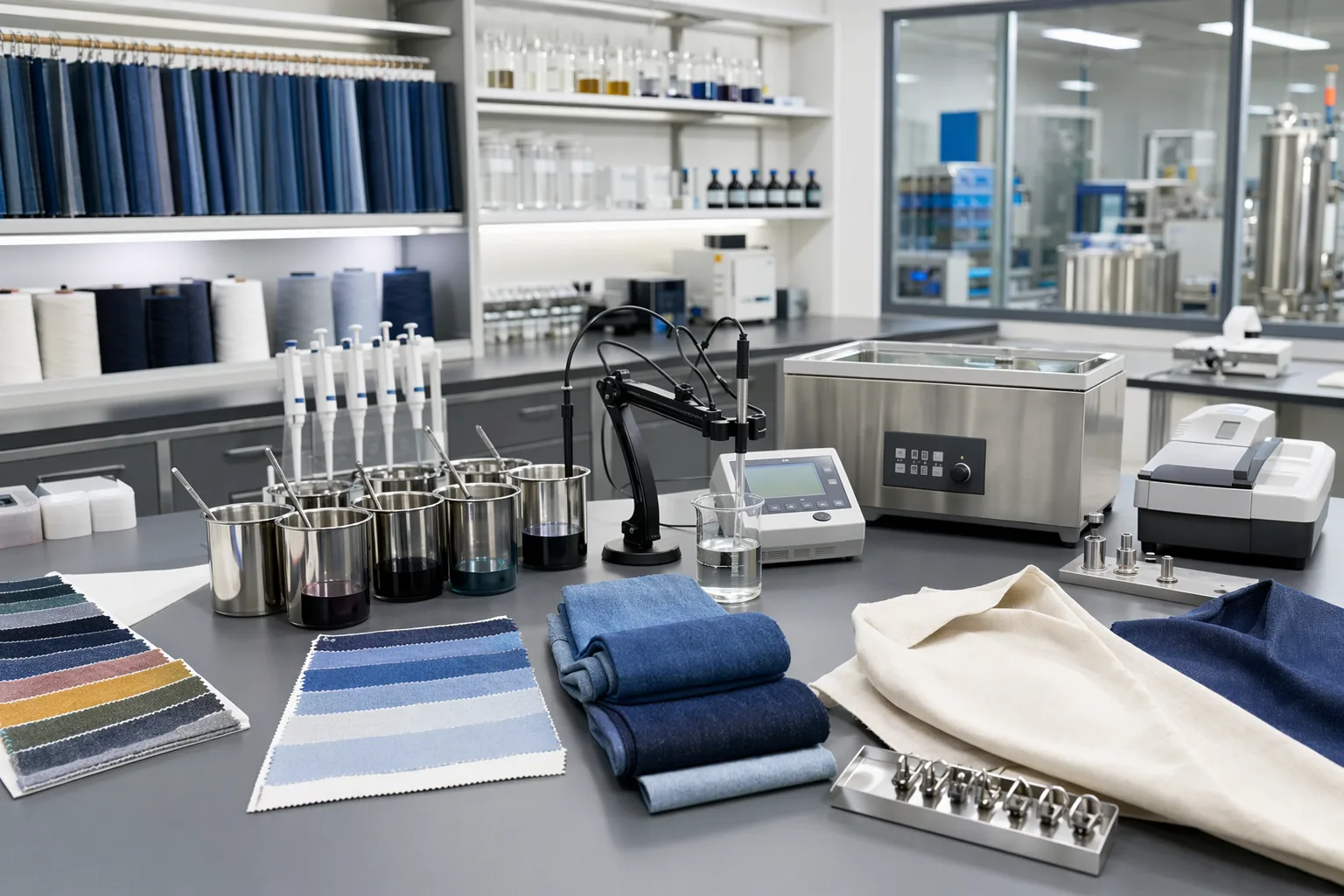
A practical B2B guide for mills, denim laundries, finishers, and formulators selecting textile processing enzymes for desizing, biopolishing, bleaching support, denim abrasion, and fabric finishing.
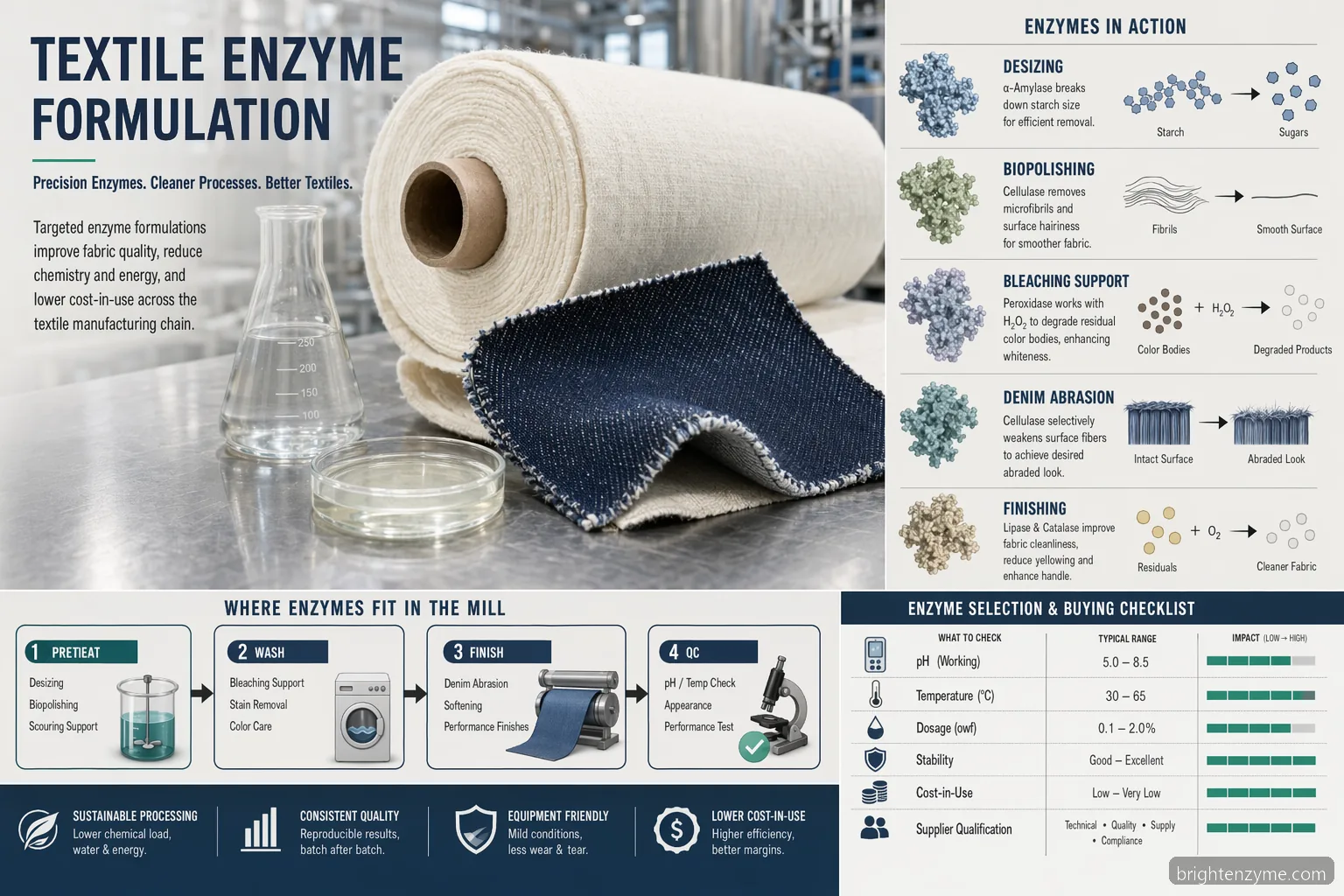
What B2B Buyers Mean by Sciencedaily Textile Enzymes
Industrial buyers searching for sciencedaily textile enzymes are usually looking for science-backed enzyme options that can be translated into repeatable textile formulations. In practice, this means identifying the right enzyme activity, confirming its working window, and proving performance on the target substrate before scale-up. Textile enzymes are not one generic ingredient. Amylases are commonly used for starch desizing, cellulases for biopolishing and denim effects, pectinases for bioscouring support, catalases for peroxide removal, and laccases for selected oxidation and shade-modification processes. The commercial decision should be based on substrate, bath conditions, equipment, process time, and compatibility with wetting agents, buffers, salts, dyes, softeners, and anti-backstaining agents. For procurement teams, the goal is not only enzyme activity per gram but stable, documented, cost-effective performance in mill conditions.
Define the textile operation before selecting enzyme chemistry. • Use supplier data as a starting point, not a substitute for mill trials. • Compare cost-in-use rather than price per kilogram.
Selecting Enzymes Used in the Textile Industry
The most common enzymes used in textile industry applications are selected by the material and process objective. For cotton and cotton-rich fabrics, neutral or acid cellulases can reduce surface fuzz, improve pilling resistance, and create a cleaner fabric appearance. In denim laundries, cellulases may support controlled abrasion and worn-down effects, while anti-backstaining control must be validated. Alpha-amylase products are used in desizing when starch-based sizes are present, typically before scouring, bleaching, dyeing, or finishing. Catalase is used after peroxide bleaching to reduce residual hydrogen peroxide before dyeing, helping protect dye consistency. Laccase textile applications are more specialized and should be tested carefully because oxidation systems can affect shade, fiber appearance, and auxiliary chemistry. A qualified textile enzymes manufacturer should help narrow the choice by fiber composition, process sequence, target effect, and equipment constraints.
Amylase: starch desizing. • Cellulase: biopolishing, denim abrasion, fuzz reduction. • Catalase: peroxide cleanup before dyeing. • Laccase: selected oxidation and shade effects.
Typical Formulation and Process Conditions
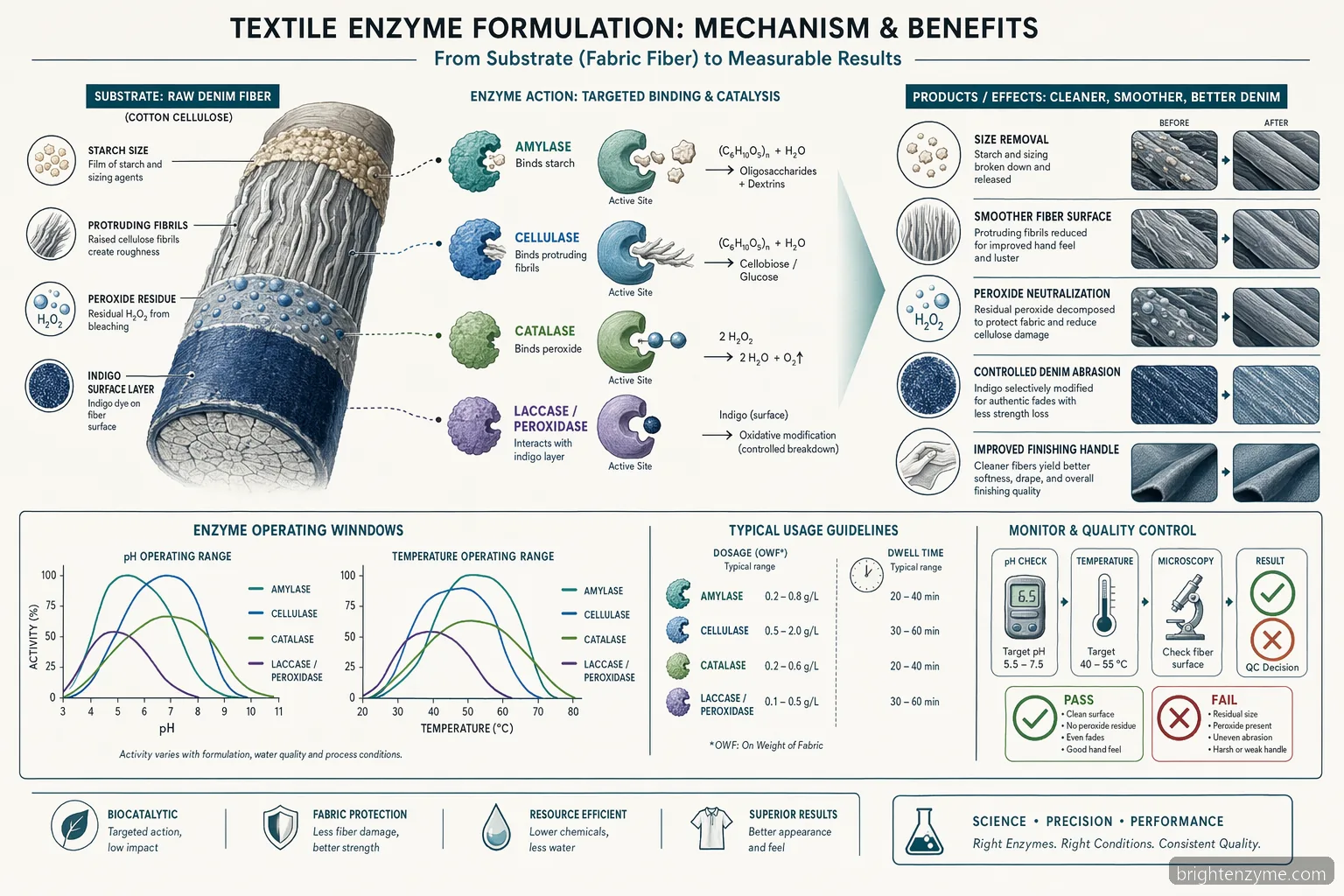
Textile processing with enzymes requires controlled pH, temperature, time, and dosage. Exact settings depend on the enzyme grade, activity unit, and fabric, but practical starting points can be defined for pilot work. Neutral cellulase often operates around pH 5.5 to 7.0 and 45 to 60 degrees Celsius, while acid cellulase may work around pH 4.5 to 5.5 and 45 to 55 degrees Celsius. Amylase desizing is commonly evaluated around pH 5.5 to 7.0 and 50 to 75 degrees Celsius, depending on enzyme type and size load. Catalase is often used near neutral pH at moderate temperatures after bleaching. Dosage may range from 0.05% to 2.0% on weight of fabric or a supplier-defined liquid dosage per liter. Always confirm tolerance to surfactants, chelants, salts, peroxide residues, and mechanical action.
Run small-lot screening before bulk production. • Control bath pH throughout treatment, not only at start. • Stop enzyme action by heat, pH shift, or rinsing as recommended. • Document liquor ratio, time, temperature, and agitation.
Pilot Validation and QC Checks
A pilot validation plan should convert supplier recommendations into measurable mill results. Begin with a control fabric and two to three enzyme dosage levels, then compare appearance, absorbency, strength retention, shade, weight loss, pilling grade, and handle. For biopolishing enzyme trials, mills often monitor fabric weight loss, Martindale or pilling rating, tensile strength, tear strength, whiteness or color change, and surface hairiness. For desizing, an iodine test can indicate residual starch, while absorbency or drop tests help confirm readiness for downstream wet processing. For catalase, residual peroxide testing is essential before dyeing. Denim trials should include backstaining rating, shade consistency, abrasion level, and seam appearance. Keep records of batch number, activity, bath chemistry, machine load, and process time so the result can be reproduced at production scale.
Use untreated and current-process controls. • Measure both visual effects and physical fabric properties. • Confirm downstream dyeing or finishing compatibility. • Retain pilot samples for buyer and production approval.
Cost-in-Use and Supplier Qualification
The textile enzymes market includes many suppliers, but qualification should be evidence-based. Request a current COA, TDS, SDS, activity assay description, recommended storage conditions, shelf-life, packaging options, and batch traceability. A reliable textile enzymes manufacturer should also support pilot design, troubleshooting, and scale-up interpretation without making unsupported performance claims. Cost-in-use should include dosage, treatment time, temperature, rewash rate, water use, energy demand, reject reduction, and whether the enzyme enables process consolidation. For example, a higher-priced biopolishing enzyme may be economical if it provides consistent pilling improvement at lower dosage or shorter processing time. Procurement should also evaluate lead time, lot-to-lot consistency, technical response speed, and documentation quality. The best supplier is the one that helps convert enzyme activity into stable production value.
Request COA, TDS, SDS, and activity method before approval. • Compare suppliers using the same fabric, bath, and QC protocol. • Include logistics, storage, and shelf-life in purchasing decisions.
Technical Buying Checklist
Buyer Questions
Start with the process objective. Use amylase for starch desizing, cellulase for biopolishing or denim abrasion, catalase for residual peroxide removal after bleaching, and laccase for specialized oxidation or shade effects. Then check fiber composition, pH, temperature, time, machinery, and auxiliary compatibility. Final selection should be based on pilot results and documented QC performance, not only on listed enzyme activity.
A practical screening range is often 0.05% to 2.0% on weight of fabric, but the correct dose depends on enzyme activity, formulation strength, liquor ratio, fabric construction, process time, and desired effect. Use the supplier TDS as the starting point, then run pilot trials at multiple dosage levels. Confirm performance with QC checks such as weight loss, pilling grade, shade, absorbency, and strength retention.
Qualified textile enzymes manufacturers should provide a COA, TDS, SDS, activity assay method, batch traceability, storage guidance, shelf-life, packaging information, and recommended process conditions. For B2B purchasing, these documents support incoming quality checks, safety review, formulation work, and supplier qualification. Buyers should also ask for technical support during pilot validation and clear guidance on enzyme deactivation or process stopping.
Validation usually begins with lab or pilot trials on the actual fabric. The mill compares untreated control, current process, and enzyme-treated samples at different dosages. Common checks include pH, temperature, residual starch, residual peroxide, absorbency, pilling grade, tensile strength, tear strength, weight loss, shade change, backstaining, and hand feel. Only after repeatable results are confirmed should the process move to production scale.
Cost-in-use includes enzyme dosage, bath time, temperature, water and energy demand, chemical reductions, rewash rate, reject rate, and effect consistency. The lowest price per kilogram is not always the lowest process cost. A more concentrated or better-matched enzyme may reduce time, improve first-pass quality, or lower downstream correction costs. Compare suppliers using the same fabric, recipe, machine conditions, and QC targets.
Textile Processing Enzymes for Research & Industry
Need Textile Processing Enzymes for your lab or production process?
ISO 9001 certified · Food-grade & research-grade · Ships to 80+ countries
Frequently Asked Questions
How do I choose between cellulase, amylase, catalase, and laccase textile enzymes?
Start with the process objective. Use amylase for starch desizing, cellulase for biopolishing or denim abrasion, catalase for residual peroxide removal after bleaching, and laccase for specialized oxidation or shade effects. Then check fiber composition, pH, temperature, time, machinery, and auxiliary compatibility. Final selection should be based on pilot results and documented QC performance, not only on listed enzyme activity.
What dosage should a mill use for textile enzymes?
A practical screening range is often 0.05% to 2.0% on weight of fabric, but the correct dose depends on enzyme activity, formulation strength, liquor ratio, fabric construction, process time, and desired effect. Use the supplier TDS as the starting point, then run pilot trials at multiple dosage levels. Confirm performance with QC checks such as weight loss, pilling grade, shade, absorbency, and strength retention.
What documents should textile enzymes manufacturers provide?
Qualified textile enzymes manufacturers should provide a COA, TDS, SDS, activity assay method, batch traceability, storage guidance, shelf-life, packaging information, and recommended process conditions. For B2B purchasing, these documents support incoming quality checks, safety review, formulation work, and supplier qualification. Buyers should also ask for technical support during pilot validation and clear guidance on enzyme deactivation or process stopping.
How are enzymes in the textile industry validated before scale-up?
Validation usually begins with lab or pilot trials on the actual fabric. The mill compares untreated control, current process, and enzyme-treated samples at different dosages. Common checks include pH, temperature, residual starch, residual peroxide, absorbency, pilling grade, tensile strength, tear strength, weight loss, shade change, backstaining, and hand feel. Only after repeatable results are confirmed should the process move to production scale.
How should cost-in-use be calculated for textile processing with enzymes?
Cost-in-use includes enzyme dosage, bath time, temperature, water and energy demand, chemical reductions, rewash rate, reject rate, and effect consistency. The lowest price per kilogram is not always the lowest process cost. A more concentrated or better-matched enzyme may reduce time, improve first-pass quality, or lower downstream correction costs. Compare suppliers using the same fabric, recipe, machine conditions, and QC targets.
Related: Textile Processing Enzymes for Faster, Cleaner Finishing
Turn This Guide Into a Supplier Brief Request textile enzyme TDS, COA, SDS, and pilot support from Bright Enzyme for your fabric finishing process. See our application page for Textile Processing Enzymes for Faster, Cleaner Finishing at /applications/textile-enzymes-manufacturers-india/ for specs, MOQ, and a free 50 g sample.
Contact Us to Contribute