Textile Enzymes Formulation for Textile Processing
Buyer guide to textile enzymes formulation, process ranges, QC, pilot validation, cost-in-use, and supplier qualification for mills.
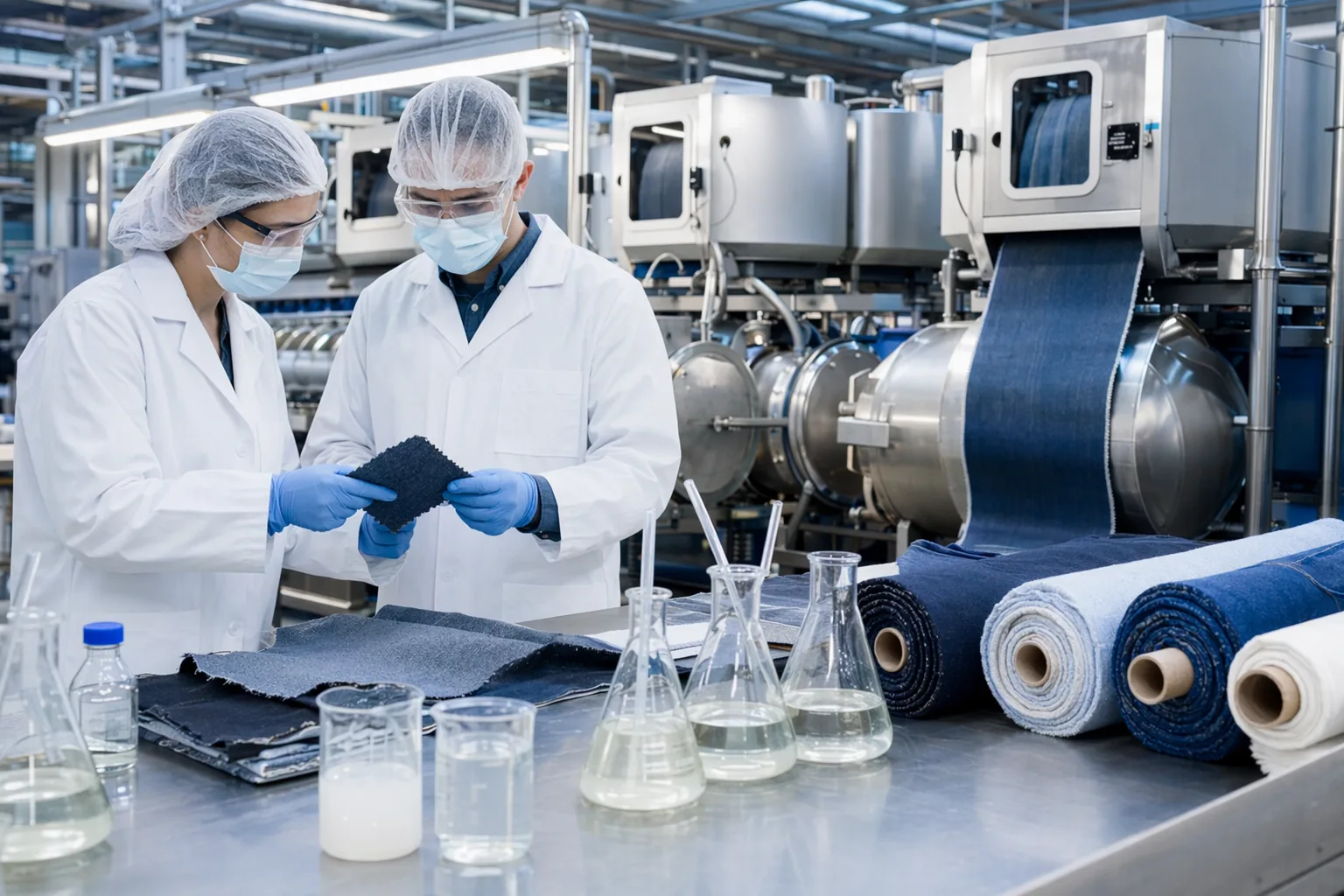
Select textile processing enzymes with practical process windows, verifiable documentation, and pilot data that support reliable fabric finishing, denim effects, and mill-scale economics. For a bulk quote for your mill or auxiliary blend, send the product, quantity and destination.
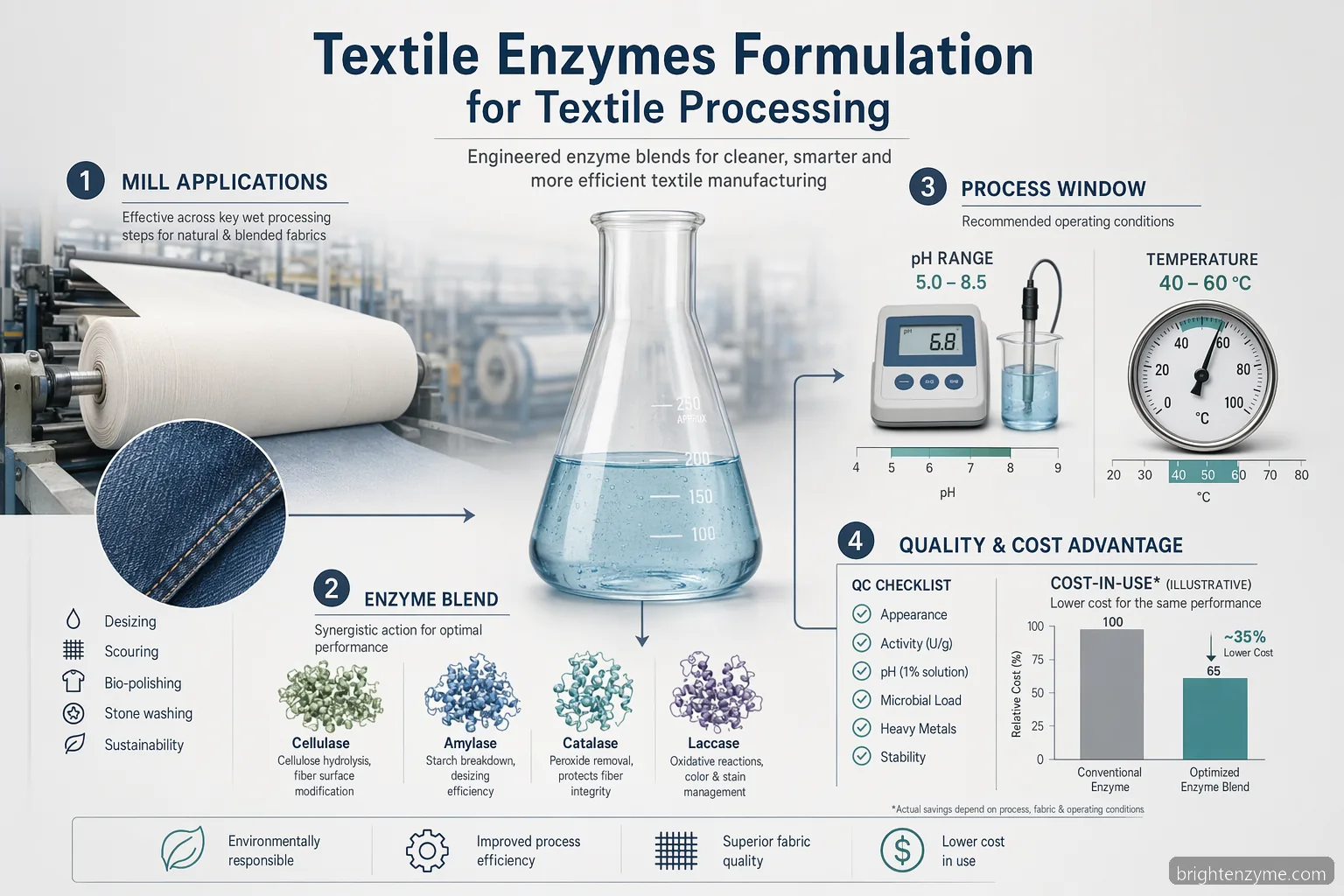
Why Textile Enzymes Formulation Matters for Buyers
A textile enzymes formulation is not just a single activity number on a label. For mills and finishing plants, the formulation must match fiber type, pretreatment history, water quality, dye chemistry, equipment, and the desired hand feel or appearance. Enzymes used in textile industry applications can reduce harsh chemical steps, but performance depends on controlled pH, temperature, time, agitation, and inactivation. A supplier should help translate lab activity into a practical mill recipe, including dosage bands and expected process limits. For buyer-intent sourcing, compare textile enzymes manufacturers on documentation, batch consistency, technical support, and pilot trial responsiveness. The best choice is usually the product that delivers the target effect at the lowest controlled cost-in-use, not simply the lowest price per kilogram.
Match enzyme class to fiber and process objective. • Check compatibility with surfactants, salts, dyes, and auxiliaries. • Validate performance on actual mill fabric before bulk purchase.
Key Enzyme Classes Used in Textile Processing
Textile processing with enzymes commonly uses amylase for starch desizing, cellulase for biopolishing and denim abrasion, pectinase for bioscouring cotton, catalase for peroxide removal, laccase for denim shade modification or phenolic oxidation systems, and protease for selected protein-fiber or specialty finishing routes. Typical operating ranges vary by product, so the supplier TDS should be the controlling document. As a general starting point, alpha-amylase may run near pH 5.5-7.0 and 50-75°C; cellulase often works near pH 4.5-6.0 and 45-60°C; pectinase may operate near pH 6.5-8.5 and 45-60°C; catalase often works near pH 6.0-8.0 and 30-50°C. Laccase textile applications frequently require controlled pH, mediator policy review, and careful shade testing.
Amylase: starch desizing before dyeing or finishing. • Cellulase: biopolishing enzyme and denim abrasion effects. • Pectinase: cotton bioscouring support. • Catalase: residual peroxide cleanup before dyeing. • Laccase: denim and specialty oxidation effects.
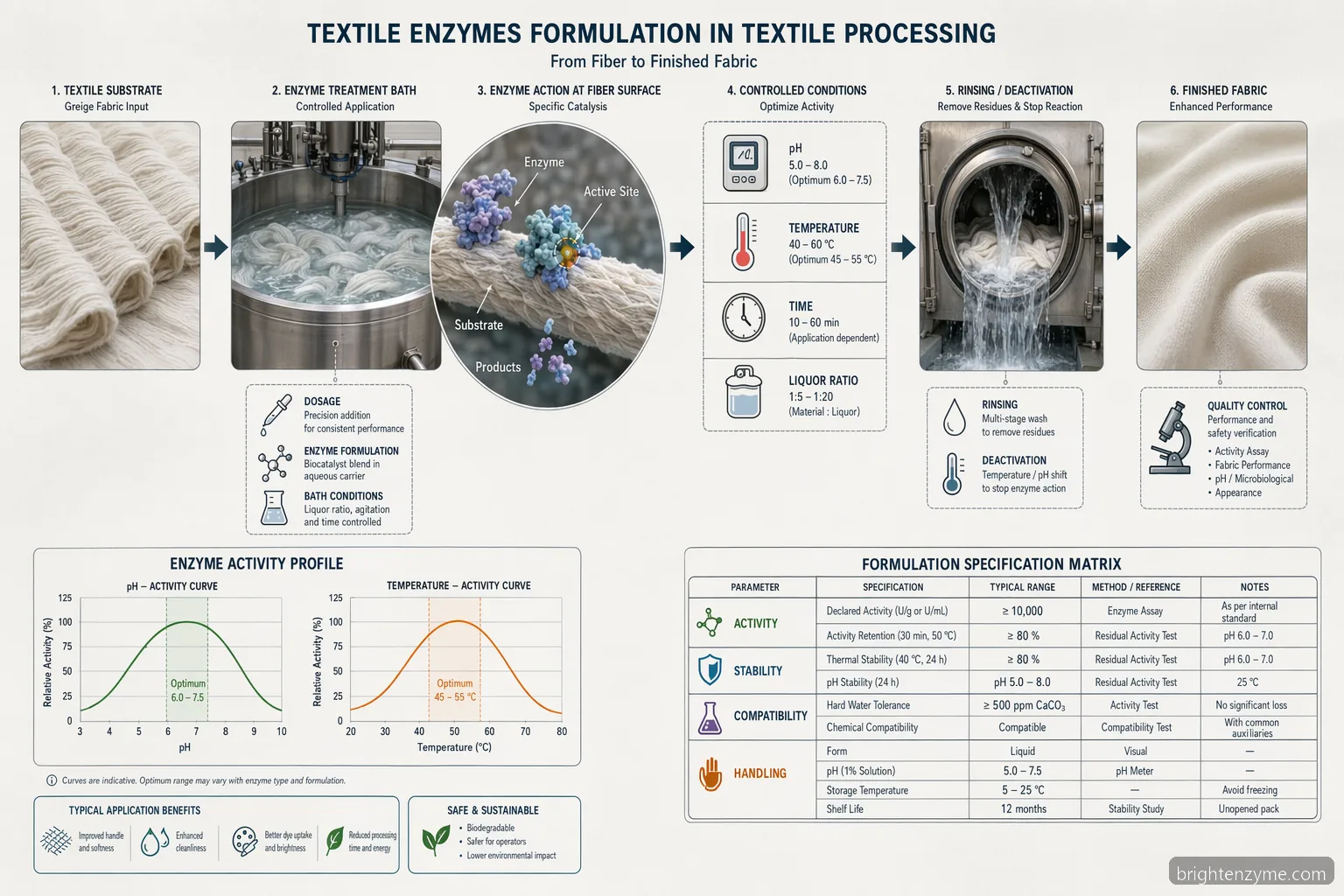
Application Design for Denim, Biopolishing, and Finishing
For denim, textile enzymes can create abrasion, contrast, and softer hand while reducing reliance on aggressive mechanical or chemical treatments. Neutral or acidic cellulase selection should consider backstaining risk, indigo shade target, garment load, stone use, and machine action. For knitted or woven cotton biopolishing, the objective is controlled surface fiber removal without unacceptable strength loss or excess weight loss. Typical cellulase dosage may start around 0.2-2.0% owg or a supplier-defined g/L range, with 30-60 minutes contact time, but fabric construction and desired effect drive optimization. In fabric finishing, enzyme textile processing should include a clear inactivation step, such as pH shift, temperature increase, washing, or chemical stop where appropriate. QC should compare treated and untreated controls for appearance, pilling tendency, tensile strength, shade, absorbency, and hand feel.
Run side-by-side controls during trials. • Measure weight loss and strength retention. • Confirm shade impact before production release.
Formulation Stability, Compatibility, and Handling
Industrial textile enzymes formulation requires attention to liquid or powder stability, preservative system, carrier choice, dust control, dilution behavior, and storage conditions. Enzymes are proteins, so high heat, extreme pH, oxidizers, heavy metals, and incompatible biocides can reduce activity. Buyers should ask whether the product is designed for direct dosing, premix tanks, continuous ranges, garment washers, or exhaust processes. Typical storage guidance may be cool, dry, sealed, and protected from sunlight, but the SDS and TDS should define actual requirements. Compatibility screening should include common wetting agents, sequestering agents, buffers, anti-backstaining agents, softeners, salts, peroxide residues, and dye bath carryover. A capable textile enzymes manufacturer will provide practical recommendations for dilution water, hold time after dilution, tank cleaning, and safe operator handling.
Avoid uncontrolled exposure to oxidizers and extreme pH. • Check diluted enzyme hold-time limits. • Use SDS guidance for PPE, storage, and spill response.
Documentation, QC Checks, and Pilot Validation
Before approving a textile enzymes supplier, request a current COA, TDS, SDS, specification sheet, activity test method, recommended application procedure, shelf-life statement, and packaging options. The COA should identify batch number, activity or potency result, appearance, and other relevant release criteria. The TDS should define process window, dosage guidance, inactivation, and compatibility limitations. Pilot validation should use production-representative fabric, water, auxiliaries, liquor ratio, machine type, temperature ramp, and cycle time. Useful QC checks include residual starch after desizing, absorbency drop test after bioscouring, peroxide strip after catalase, pilling rating after biopolishing, color difference measurement, tensile or tear strength, weight loss, and hand-feel panel review. Documenting these results helps convert supplier claims into mill-specific operating limits.
Require batch-level COA for incoming QC. • Use TDS conditions as the trial baseline. • Keep pilot records for scale-up troubleshooting.
Cost-in-Use and Supplier Qualification
The textile enzymes market includes commodity products and specialized formulations, so procurement should evaluate total value rather than unit price alone. Cost-in-use includes enzyme dosage, bath ratio, processing time, heating demand, rewash rate, fabric downgrades, effluent treatment impact, labor, and inventory stability. A higher-priced formulation may be economical if it shortens cycles, improves first-pass quality, or reduces shade variation. Supplier qualification should review manufacturing consistency, technical service response, sample availability, lead time, packaging integrity, change-control communication, and ability to support troubleshooting. For global sourcing, confirm import documentation, lot traceability, and realistic shelf life under your storage conditions. Bright Enzyme supports B2B buyers comparing enzymes in textile industry applications with practical evaluation steps for lab, pilot, and production approval.
Compare cost per treated kilogram of fabric. • Assess supplier support, not only activity units. • Confirm lead time and lot traceability before scale-up.
Technical Buying Checklist
Buyer Questions
A textile enzymes formulation is an industrial enzyme product designed for a specific textile process, such as desizing, bioscouring, biopolishing, denim abrasion, peroxide removal, or specialty finishing. It may include the enzyme protein plus stabilizers, carriers, buffers, preservatives, or processing aids. Buyers should evaluate the formulation by process performance, stability, documentation, and cost-in-use, not only by enzyme activity units.
Common enzymes in textile industry applications include amylase for starch desizing, cellulase for biopolishing enzyme treatments and denim effects, pectinase for cotton bioscouring, catalase for hydrogen peroxide removal, laccase for selected denim or oxidation effects, and protease for specialty uses. The correct choice depends on fiber, pretreatment, dye system, equipment, target appearance, and acceptable strength or shade change.
Start with the supplier TDS, then run lab and pilot trials using actual fabric, water, auxiliaries, machine conditions, and liquor ratio. Record pH, temperature, time, dosage, agitation, and inactivation method. Compare treated samples with controls for shade, pilling, absorbency, weight loss, strength, hand feel, and rewash rate. Confirm repeatability before moving to bulk purchasing.
Qualified textile enzymes manufacturers should provide a COA for each batch, a TDS with process recommendations, an SDS for safe handling, an activity or assay method, storage and shelf-life guidance, and compatibility notes. For new projects, buyers should also request sample support, application guidance, packaging details, and change-control communication for significant formulation or manufacturing changes.
Cost-in-use is calculated from the dosage needed to treat a defined weight of fabric, plus effects on processing time, energy, water, rework, fabric loss, and quality consistency. A low-price enzyme may be costly if it requires high dosage or causes shade variation. Compare suppliers using pilot results, not only quotation price, to identify the most economical production recipe.
Textile Processing Enzymes for Research & Industry
Need Textile Processing Enzymes for your lab or production process?
ISO 9001 certified · Food-grade & research-grade · Ships to 80+ countries
Frequently Asked Questions
What is a textile enzymes formulation?
A textile enzymes formulation is an industrial enzyme product designed for a specific textile process, such as desizing, bioscouring, biopolishing, denim abrasion, peroxide removal, or specialty finishing. It may include the enzyme protein plus stabilizers, carriers, buffers, preservatives, or processing aids. Buyers should evaluate the formulation by process performance, stability, documentation, and cost-in-use, not only by enzyme activity units.
Which enzymes are commonly used in the textile industry?
Common enzymes in textile industry applications include amylase for starch desizing, cellulase for biopolishing enzyme treatments and denim effects, pectinase for cotton bioscouring, catalase for hydrogen peroxide removal, laccase for selected denim or oxidation effects, and protease for specialty uses. The correct choice depends on fiber, pretreatment, dye system, equipment, target appearance, and acceptable strength or shade change.
How should a mill validate textile enzymes before production?
Start with the supplier TDS, then run lab and pilot trials using actual fabric, water, auxiliaries, machine conditions, and liquor ratio. Record pH, temperature, time, dosage, agitation, and inactivation method. Compare treated samples with controls for shade, pilling, absorbency, weight loss, strength, hand feel, and rewash rate. Confirm repeatability before moving to bulk purchasing.
What documents should textile enzymes manufacturers provide?
Qualified textile enzymes manufacturers should provide a COA for each batch, a TDS with process recommendations, an SDS for safe handling, an activity or assay method, storage and shelf-life guidance, and compatibility notes. For new projects, buyers should also request sample support, application guidance, packaging details, and change-control communication for significant formulation or manufacturing changes.
How do buyers calculate cost-in-use for textile enzymes?
Cost-in-use is calculated from the dosage needed to treat a defined weight of fabric, plus effects on processing time, energy, water, rework, fabric loss, and quality consistency. A low-price enzyme may be costly if it requires high dosage or causes shade variation. Compare suppliers using pilot results, not only quotation price, to identify the most economical production recipe.
Request a quote: product, quantity, destination
Request a textile enzymes formulation sample, TDS, SDS, and pilot trial discussion from Bright Enzyme. See our application page for Textile Processing Enzymes for Faster, Cleaner Finishing for specs, MOQ, and a free 50 g sample.
Contact Us to Contributehello@mail.brightenzyme.com