Textile Enzymes Manufacturer for Textile Processing
Choose a textile enzymes manufacturer for desizing, biopolishing, denim and finishing with process ranges, QC checks and supplier qualification tips.
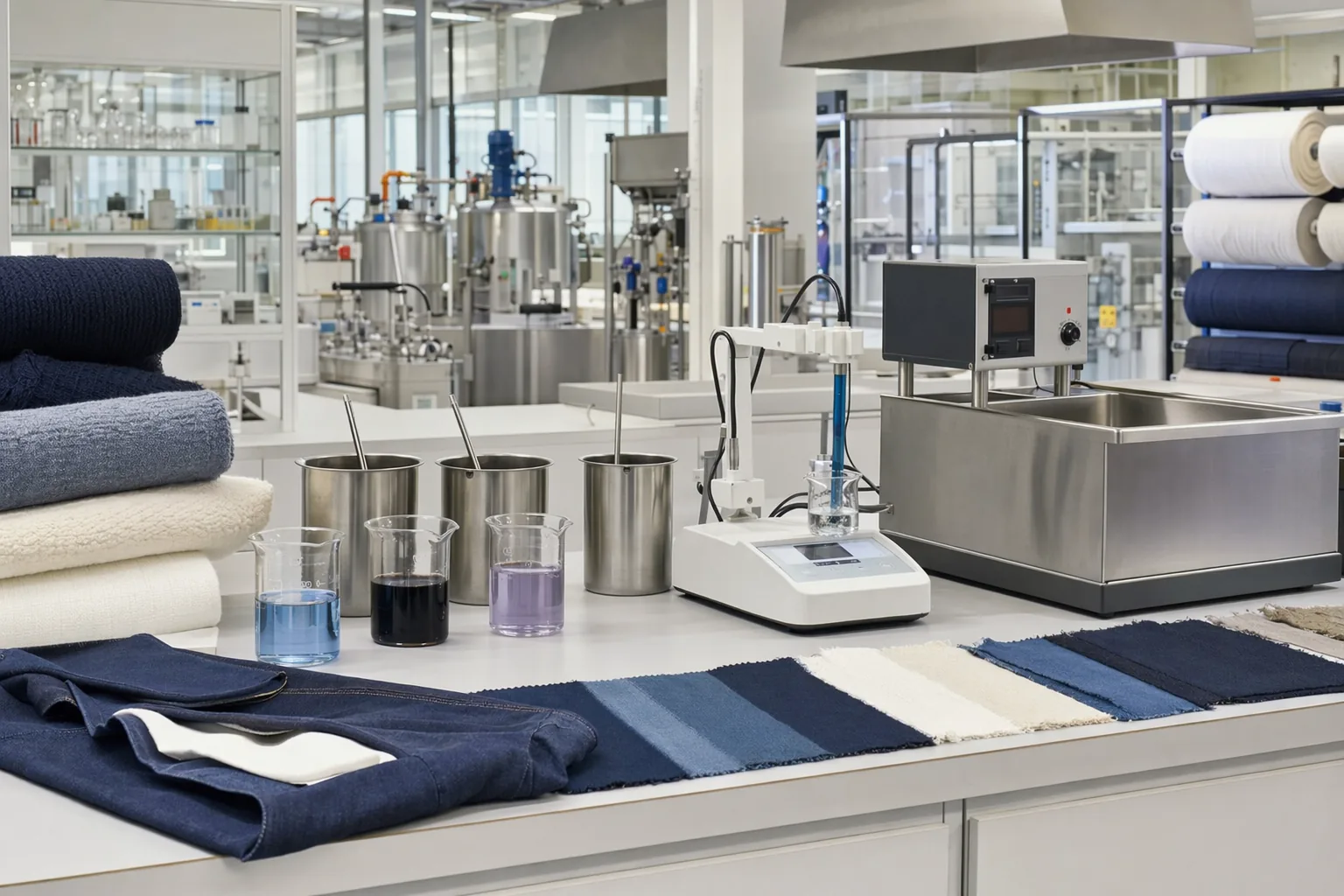
A practical B2B guide for mills, dye houses and garment processors sourcing textile enzymes for consistent, lower-impact fabric preparation and finishing.
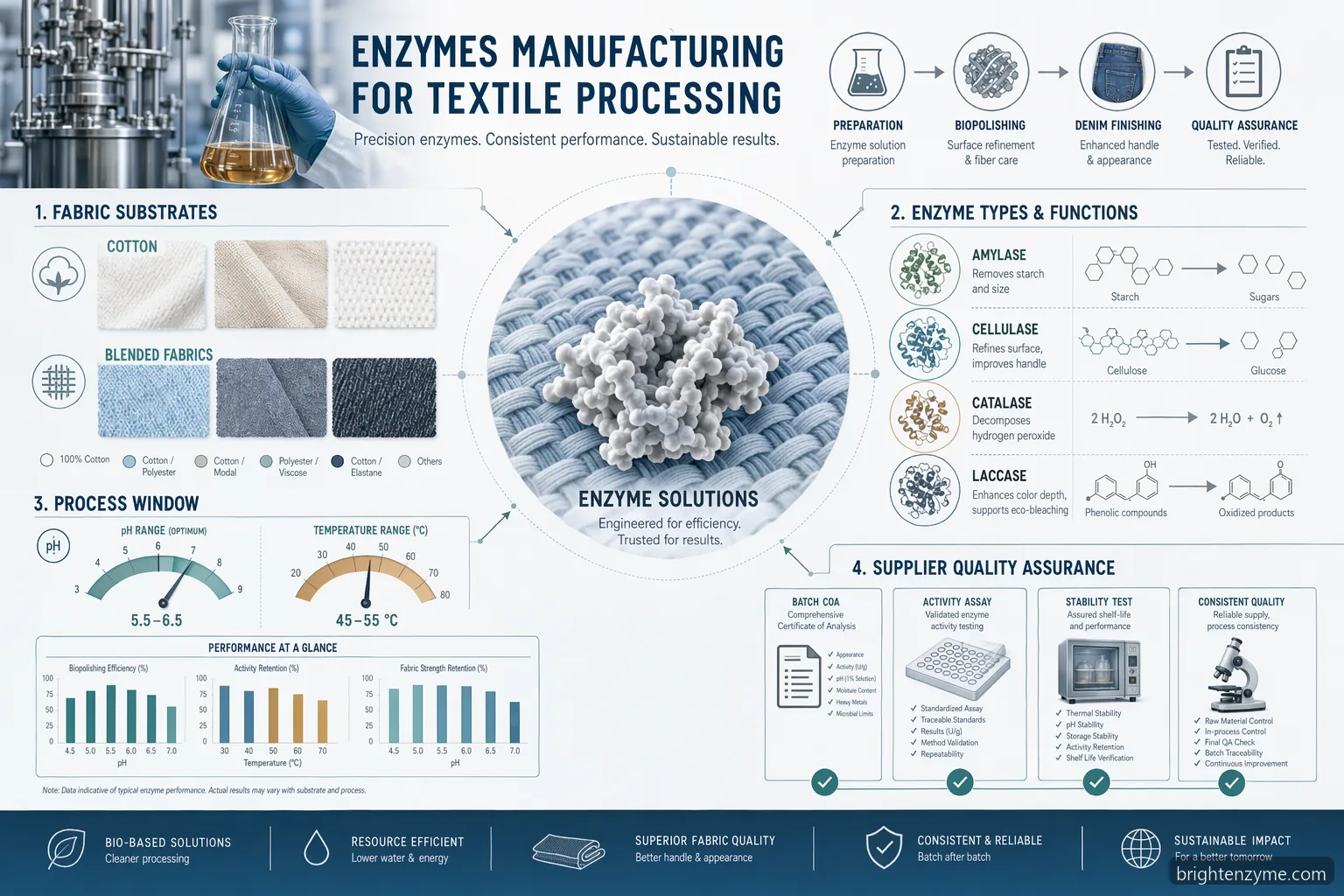
What textile enzymes do in industrial processing
Textile enzymes are process aids used to improve preparation, finishing and denim effects under controlled aqueous conditions. In the textile industry, common enzyme classes include amylases for starch desizing, cellulases for biopolishing and denim abrasion, pectinases for bio-scouring, catalases for peroxide removal and laccases for selected color or surface-modification applications. For buyers, the goal is not simply to purchase an enzyme; it is to define a repeatable process window that delivers fabric performance with acceptable shade, strength, handle and rework rate. A reliable textile enzymes manufacturer should help translate mill objectives into product selection, dosing guidance and validation trials. Because fabric construction, yarn quality, dye chemistry and machine type affect results, textile processing with enzymes should be qualified on the actual substrate and equipment whenever possible.
Desizing: starch breakdown before scouring or dyeing • Biopolishing: reduced fuzz and improved surface appearance • Denim: controlled abrasion and cleaner wash-down effects • Finishing: softer hand, clearer shade or process simplification
Key enzyme types and typical process windows
Process conditions vary by formulation, but practical starting ranges help technical buyers plan trials. Neutral or thermostable amylases are often evaluated around pH 5.5-7.5 and 50-90°C depending on desizing equipment and dwell time. Acid cellulases for denim and biopolishing may run near pH 4.5-5.5 and 45-60°C, while neutral cellulases may support processes closer to pH 6.0-7.0. Catalase for peroxide kill is commonly assessed around pH 6.0-8.0 and 30-60°C after bleaching. Laccase textile applications depend heavily on mediator system, substrate and shade target, so lab approval is essential. Dosage should be expressed as product percentage on fabric weight, grams per liter or activity units, and should be optimized against time, liquor ratio and mechanical action.
Use supplier TDS values as starting points, not final recipes • Confirm enzyme compatibility with salts, surfactants, dyes and auxiliaries • Define a reliable stop step by pH shift, heat or washing • Track tensile strength and shade change during optimization
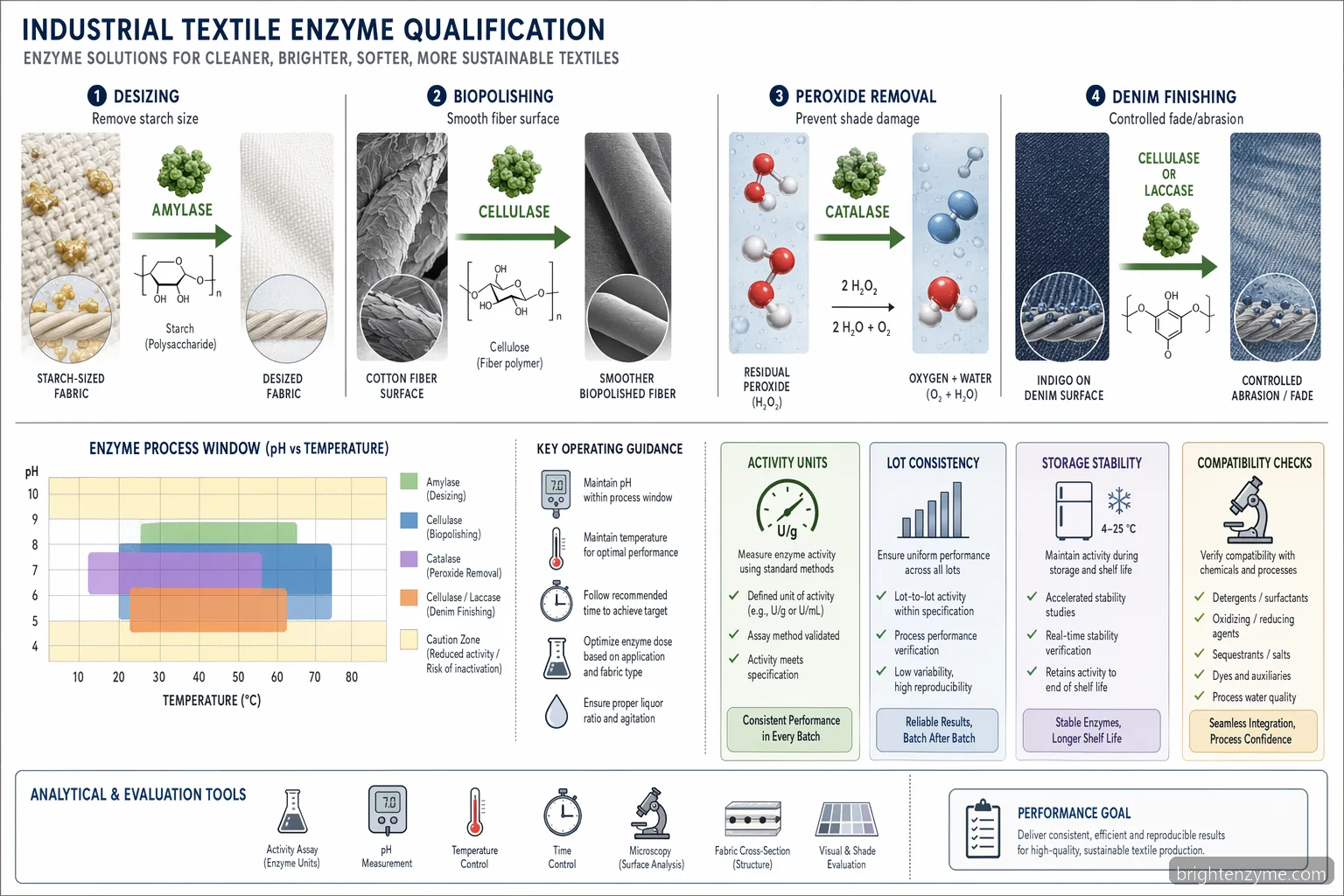
Biopolishing enzyme selection for cotton and blends
A biopolishing enzyme is typically a cellulase formulation designed to remove protruding microfibrils from cotton, viscose and selected cellulosic blends. The buying decision should focus on surface improvement without unacceptable weight loss, strength reduction or shade shift. Mills should run lab dips across dosage bands such as 0.2-1.5% owf, then adjust for fabric GSM, knit or woven structure, bath ratio and machine action. Evaluation should include pilling grade, hand feel, absorbency, whiteness or shade, weight loss and burst or tensile strength. For dyed goods, back staining and color change must be checked before approval. A competent textile enzymes manufacturer will recommend whether acid, neutral or low-back-staining cellulase is more appropriate for the mill’s process route.
Start low on dosage when fabric strength retention is critical • Use replicate swatches to separate enzyme effect from mechanical abrasion • Stop the enzyme fully before downstream softening or dye correction • Document approved recipe conditions in the mill process sheet
Denim and garment finishing with enzymes
Enzymes used in textile industry denim processing help create abrasion, softness and worn-down visual effects with fewer harsh mechanical or chemical steps when properly controlled. Cellulases are widely used in garment washers, often under acidic or neutral conditions selected for the desired contrast and back-staining profile. Laccase textile systems may be considered for specific indigo modification, but they require careful shade approval and compatibility review. Denim processors should validate enzyme dosage, pumice or pumice-free operation, liquor ratio, garment load, rotation speed, time and temperature. QC checks should include shade measurement, panel-to-panel variation, seam damage, tensile retention and wash fastness. For export-oriented garment programs, batch traceability and repeatability are as important as the first sample appearance.
Control garment load and mechanical action for reproducible abrasion • Measure shade before and after softening or neutralization • Check pocketing, seams and elastane-containing fabrics separately • Maintain batch records for recipe, enzyme lot and wash conditions
Supplier documentation and batch quality checks
Industrial buyers should request a Certificate of Analysis, Technical Data Sheet and Safety Data Sheet before approving textile enzymes. The COA should identify product name, batch number, manufacture or release date where available, key activity or specification range, appearance and storage guidance. The TDS should state recommended pH, temperature, dosage and application method, while the SDS supports safe handling, spill response and transport review. Incoming QC can include appearance, odor, pH, density or solids where relevant, plus a simple performance assay on a standard fabric or starch substrate. This is especially important when comparing textile enzymes manufacturers, because equal product pricing does not guarantee equal activity, stability or performance under mill conditions.
Keep retained samples for approved production lots • Check storage temperature and shelf-life requirements • Verify performance on a standard internal substrate • Record deviations, complaints and corrective actions by batch
How to qualify a textile enzymes manufacturer
Supplier qualification should combine technical, commercial and operational checks. Buyers searching for a textile enzymes manufacturer in India or other sourcing regions should evaluate response time, application knowledge, documentation completeness, batch consistency, lead time, packaging options and ability to support pilot validation. Ask for a defined trial protocol, recommended control sample and measurable acceptance criteria. Compare cost-in-use by calculating enzyme dose, dilution, processing time, energy, rework, rejects and downstream chemical savings. The textile enzymes market includes broad commodity products and specialized formulations, so a structured qualification process protects both quality and margin. Final approval should be based on plant results, not only brochure claims or unit price.
Request COA, TDS and SDS before commercial purchase • Run lab, pilot and first-batch production validation • Compare cost per processed kilogram of fabric • Assess supply reliability, packaging integrity and technical support
Technical Buying Checklist
Buyer Questions
Choose a supplier that can support your application with COA, TDS, SDS, trial guidance and batch-to-batch consistency. Ask for starting recipes, pH and temperature windows, dosage recommendations and stop-step instructions. Then validate on your fabric, machinery and auxiliaries. The best textile enzymes manufacturer for a mill is the one that delivers repeatable plant performance at the lowest cost-in-use, not just the lowest product price.
Common textile enzymes include amylases for starch desizing, cellulases for biopolishing and denim abrasion, pectinases for bio-scouring, catalases for peroxide removal and laccases for selected color or surface-modification processes. The correct choice depends on fiber type, fabric construction, dyeing route, machine conditions and the required finish. Enzymes in textile industry applications should always be confirmed through lab and pilot trials.
Before plant trials, confirm pH, temperature, dosage, liquor ratio, time, agitation, substrate type and chemical compatibility. Also define how the enzyme will be stopped, such as by heating, pH shift or washing. Set QC targets for shade, absorbency, pilling, weight loss and strength. These controls help textile processing with enzymes move from sample approval to repeatable production.
Price per kg ignores enzyme activity, dosage, processing time, rework, rejects and downstream chemical or energy savings. A higher-priced formulation may be more economical if it works at a lower dose, reduces cycle time or improves first-pass quality. Cost-in-use should be calculated per kg of processed fabric using actual mill results, including performance losses and any required neutralization or washing steps.
Usually not. Desizing, biopolishing, denim finishing, bio-scouring and peroxide removal require different enzyme activities and operating windows. Even within cellulases, acid, neutral and low-back-staining formulations can perform differently on cotton knits, woven fabrics and denim garments. Buyers should avoid one-size-fits-all selection and instead qualify each product against the specific fabric, process route and quality target.
Textile Processing Enzymes for Research & Industry
Need Textile Processing Enzymes for your lab or production process?
ISO 9001 certified · Food-grade & research-grade · Ships to 80+ countries
Frequently Asked Questions
How do I choose the right textile enzymes manufacturer?
Choose a supplier that can support your application with COA, TDS, SDS, trial guidance and batch-to-batch consistency. Ask for starting recipes, pH and temperature windows, dosage recommendations and stop-step instructions. Then validate on your fabric, machinery and auxiliaries. The best textile enzymes manufacturer for a mill is the one that delivers repeatable plant performance at the lowest cost-in-use, not just the lowest product price.
Which enzymes are commonly used in textile processing?
Common textile enzymes include amylases for starch desizing, cellulases for biopolishing and denim abrasion, pectinases for bio-scouring, catalases for peroxide removal and laccases for selected color or surface-modification processes. The correct choice depends on fiber type, fabric construction, dyeing route, machine conditions and the required finish. Enzymes in textile industry applications should always be confirmed through lab and pilot trials.
What process conditions should be checked before plant trials?
Before plant trials, confirm pH, temperature, dosage, liquor ratio, time, agitation, substrate type and chemical compatibility. Also define how the enzyme will be stopped, such as by heating, pH shift or washing. Set QC targets for shade, absorbency, pilling, weight loss and strength. These controls help textile processing with enzymes move from sample approval to repeatable production.
Why is cost-in-use better than comparing enzyme price per kg?
Price per kg ignores enzyme activity, dosage, processing time, rework, rejects and downstream chemical or energy savings. A higher-priced formulation may be more economical if it works at a lower dose, reduces cycle time or improves first-pass quality. Cost-in-use should be calculated per kg of processed fabric using actual mill results, including performance losses and any required neutralization or washing steps.
Can one enzyme product work for all textile applications?
Usually not. Desizing, biopolishing, denim finishing, bio-scouring and peroxide removal require different enzyme activities and operating windows. Even within cellulases, acid, neutral and low-back-staining formulations can perform differently on cotton knits, woven fabrics and denim garments. Buyers should avoid one-size-fits-all selection and instead qualify each product against the specific fabric, process route and quality target.
Related: Textile Processing Enzymes for Faster, Cleaner Finishing
Turn This Guide Into a Supplier Brief Contact Bright Enzyme for textile enzyme selection, pilot validation support and COA/TDS/SDS-backed supply for your mill or garment wash process. See our application page for Textile Processing Enzymes for Faster, Cleaner Finishing at /applications/textile-enzymes-manufacturers-india/ for specs, MOQ, and a free 50 g sample.
Contact Us to Contribute